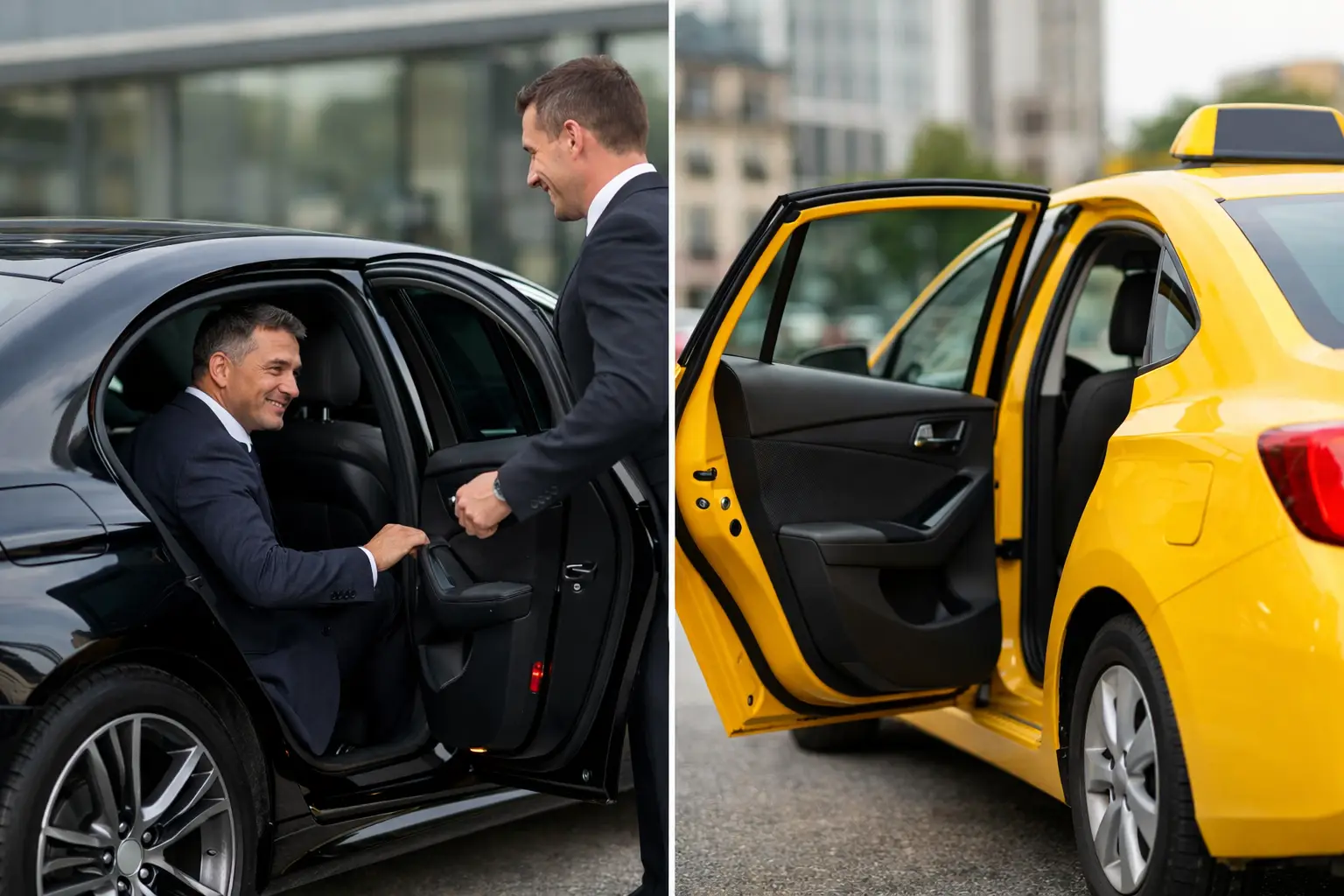
A 4am airport run tells you almost everything you need to know about executive transfer versus standard taxi. When timing is tight, luggage is awkward and there is no room for delays, the difference between basic transport and a properly planned journey becomes very obvious very quickly.
For some trips, a standard taxi is perfectly adequate.
If you need a quick lift across town on a quiet afternoon, there is little point paying for more service than you need. But when the journey matters – airport departures, client meetings, weddings, race days or long-distance travel – the better question is not simply what costs less at first glance.
It is what gives you the best overall value, the least stress and the strongest chance of arriving exactly as planned.
Executive transfer versus standard taxi: what changes in practice?
The simplest distinction is that a standard taxi usually focuses on point-to-point transport, while an executive transfer is built around the whole journey. That difference affects everything from booking and pricing to punctuality, vehicle quality and how problems are handled if plans change.
A taxi is often booked for convenience in the moment. An executive transfer is typically pre-booked, scheduled and managed with more attention to detail.
If you are travelling to Heathrow for a morning flight, heading to a major sporting venue, or moving a senior colleague between meetings, that planning matters. It means someone has already considered collection time, traffic patterns, luggage requirements and timing at the destination.
That does not make one universally better than the other. It means they serve different expectations. A standard taxi is built for basic mobility. An executive transfer is designed for journeys where reliability, presentation and comfort are part of the service.
Price is not always as simple as it looks
Price is usually the first thing people compare, and understandably so. A standard taxi can appear cheaper, especially for short local journeys. If the fare is metered, though, the final cost may shift with traffic, diversions, waiting time or route changes. On a straightforward trip this may not matter much. On a long-distance run or an airport journey in heavy traffic, it can make budgeting less certain.
Executive transfers are usually quoted in advance as a fixed fare. That gives you clarity before the car arrives. For business travellers and families alike, that certainty is useful. You know what the journey will cost, you can plan around it, and there is no concern about the meter climbing while you sit in congestion on the M6.
This is where the trade-off becomes more nuanced. If you are travelling two miles home after dinner, fixed-fare executive travel may be more than you need. If you are going from the Midlands to Gatwick with cases, children and a strict check-in time, fixed pricing often feels less like a premium and more like common sense.
Reliability matters most when the journey cannot go wrong
The strongest argument in favour of executive travel is reliability. A standard taxi can be entirely dependable, but the service model is not always built around time-critical journeys. Availability can vary, vehicle standards may differ and the experience often depends on who is on shift and how busy things are.
An executive transfer is usually structured for pre-arranged punctuality. Drivers expect the job, timings are planned in advance and the service is centred on getting the passenger to the destination without uncertainty. That is especially relevant for airport transfers, where being late is not a minor inconvenience. It can mean missed check-in, extra charges or a ruined start to the trip.
For return airport collections, the gap becomes even clearer. A standard taxi may collect when called, but executive services often monitor flights and adjust the pick-up time if the aircraft lands early or late. That saves you from standing outside a terminal trying to rebook transport after a delay.
Comfort is more than leather seats
People often think of executive transport as simply a nicer car. In reality, comfort is partly about the vehicle and partly about how the trip is managed.
Yes, an executive vehicle will usually offer a cleaner interior, more leg room and a quieter ride. That matters on longer journeys. Arriving at Manchester Airport after two hours in an uncomfortable vehicle is very different from arriving relaxed and ready to travel.
But comfort also means having enough boot space, a professional driver who helps with luggage, and a smooth style of driving suited to business passengers, families or older travellers. It means not feeling rushed, cramped or uncertain about whether the car that turns up is suitable for the job.
For professionals, comfort often overlaps with usefulness. A well-managed executive journey gives you a calm space to make calls, check emails or prepare for a meeting. In that context, the vehicle is not just transport. It becomes part of the working day.
Presentation and professionalism can affect the occasion
There are journeys where presentation genuinely matters. Corporate travel is the obvious example. If a client, director or guest speaker is being collected, the quality of the vehicle and the conduct of the driver reflect on the organisation arranging the trip.
The same applies to weddings, hospitality travel and important events. A standard taxi may get someone there, but it does not always create the right impression. Executive travel is meant to feel polished, discreet and organised. The driver is not just taking the fare. They are representing a service standard.
That said, not every journey needs that level of presentation. If practicality is the only concern, a standard taxi may do the job perfectly well. The point is to match the service to the importance of the trip.
Which is better for airports?
For airports, executive transfer versus standard taxi is rarely just a question of comfort. It is usually a question of control.
Airport travel has more moving parts than ordinary local trips. You need the right collection time, enough space for luggage, awareness of traffic conditions, and a return plan that works if your inbound flight changes. Parking, terminal access and pick-up coordination all add complexity.
This is why many travellers choose executive airport transfers even if they use taxis for other journeys. The service is usually built around airport logistics rather than simple transport. Fixed fares, flight tracking, meet-and-greet options and pre-booked scheduling remove several of the common failure points.
For a family starting a holiday, that means less hassle at the beginning and end of the trip. For a business traveller, it means less risk. And for anyone arriving back in the UK late at night, it means knowing the car is already arranged.
Where a standard taxi still makes sense
An honest comparison should say this clearly: standard taxis remain useful, and in many situations they are the sensible choice.
If the journey is local, flexible and low stakes, a taxi is often the most practical option. You may not need an executive vehicle to get to a restaurant, a friend’s house or a nearby train station. The speed and simplicity of booking can be an advantage.
Budget is another factor. Some travellers simply want the lowest possible fare, and that is reasonable. If comfort, presentation and pre-planning are not priorities, paying extra would not add much value.
The key is being realistic about the type of journey you are making. Problems usually arise when people book basic transport for a journey that really needed a more managed service.
Choosing properly rather than choosing cheaply
The best choice comes down to the cost of getting it wrong. If a delay, cramped vehicle or unclear fare would only be mildly annoying, a standard taxi may be enough. If those issues would create stress, financial loss or a poor impression, executive travel is usually the wiser booking.
This is especially true for airport runs, business travel, event transfers and longer journeys where traffic, timing and luggage all matter. In those situations, a service with fixed pricing, professional drivers and planned logistics often works out better value than a cheaper option that leaves more to chance.
That is why many passengers who compare executive transfer versus standard taxi do not really stay focused on fare alone. They start looking at certainty, comfort and whether the service is built for the journey they actually need to make. Businesses such as Transporter Executive are built around that expectation – not just getting passengers from A to B, but making sure the trip runs properly from the first booking to the final drop-off.
When the journey is routine, basic transport can be enough. When the journey matters, the calmer option is usually the one that has already planned ahead.