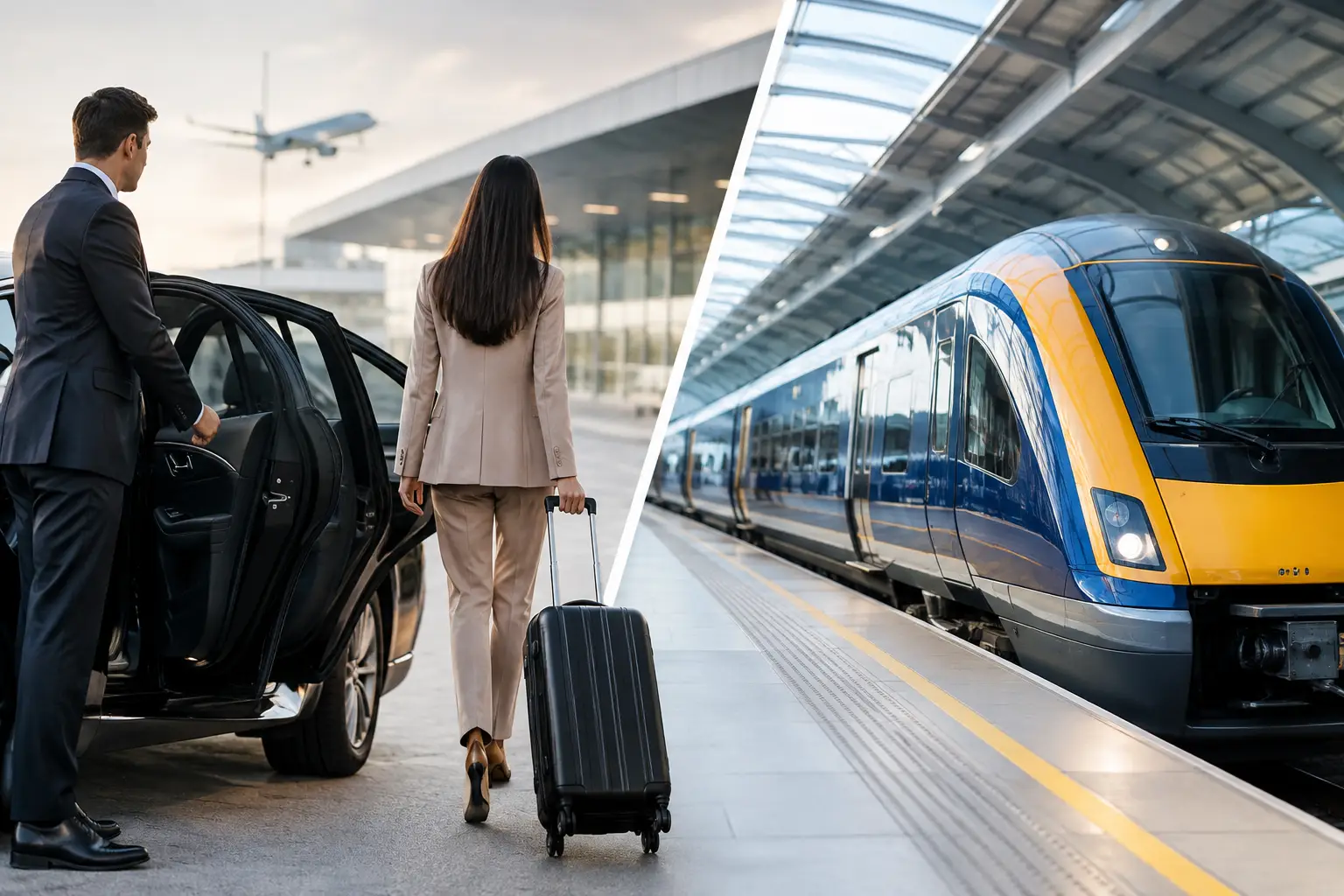
A 05:30 airport departure changes the usual executive transfer versus rail calculation. The first train may not run early enough, a connection can leave little room for disruption, and getting luggage through a busy station is rarely the relaxed start to a holiday or business trip people had in mind. Rail can be an excellent way to travel, but it is not automatically the best choice for every journey.
For airport transfers, important meetings and long-distance travel, the right option comes down to more than the headline fare. Door-to-door timing, the number of passengers, luggage, comfort, flexibility and the consequence of a delay all matter. Here is a clear comparison for travellers deciding between a chauffeur-driven executive transfer and rail.
Executive transfer versus rail: the real comparison
Rail is often the obvious choice when travelling alone between city centres on a well-served route. A direct train at the right time can be quick, productive and competitively priced when booked well ahead. It also avoids motorway traffic and the need to drive yourself.
An executive transfer works differently. It is pre-booked private travel, planned around your address, itinerary and required arrival time. Your driver collects you from home, the office or a chosen meeting point, assists with luggage, and takes you directly to the terminal, venue or hotel. There are no station changes, platform checks or onward taxi queues at the other end.
That difference is particularly valuable when the journey has a fixed deadline. Airports do not make allowances for a delayed connection, and a client meeting cannot always be moved because a service was cancelled. The best option is therefore the one that gives you enough control over the parts of the journey that matter.
Door-to-door time is more useful than timetable time
A rail journey can look faster on a timetable than it feels in practice. The advertised duration usually begins at the departure station and ends at the arrival station. It does not include the drive or taxi to the station, parking, waiting on the platform, changing trains, walking through an airport terminal or arranging the final leg after arrival.
For someone travelling from Sutton Coldfield, Birmingham or elsewhere in the Midlands, a rail trip to Heathrow or Gatwick may involve at least one change and an airport transfer after London. Even a short delay can reduce a comfortable connection into a hurried one. With children, large cases or a tight check-in time, those extra stages quickly become the main concern.
A private transfer is measured from collection to drop-off. The driver arrives at the agreed time, the vehicle is ready for your party and luggage, and the route is monitored around current traffic conditions. Road delays can still happen, of course, but the journey is planned with suitable time in hand and without a train connection to protect.
Early flights and late arrivals
This is where private travel frequently has the advantage. Early-morning flights can require a departure before practical rail services begin, especially outside a city centre. A chauffeur service operates to your booking time rather than a public timetable.
The same applies to delayed return flights. After a long flight, a cancelled train or a crowded late-night platform is not an appealing prospect. A flight-tracked airport collection provides a named plan for getting home, rather than leaving you to work out the next available service after landing.
Cost depends on who is travelling and what is included
Comparing a train ticket with the price of a private vehicle can be misleading if the comparison stops there. Rail fares vary sharply according to the time, route, flexibility and how early tickets are bought. Advance tickets can offer strong value, while peak or last-minute fares may be far higher. Add station parking, taxis at either end, seat reservations, airport connections and luggage-related inconvenience, and the total can look rather different.
An executive transfer is usually quoted as a fixed fare before travel. That gives corporate bookers and families a clear cost to approve, with no metered taxi uncertainty or surprise parking bill. For groups of three, four or more people, dividing one vehicle fare can make private travel closer to rail costs than expected, particularly on airport routes.
That does not mean an executive transfer will always be the cheaper option. A solo traveller with a flexible schedule, light luggage and access to a direct off-peak service may find rail the most economical choice. The value of a chauffeur service lies in knowing the full cost and receiving a private, direct journey built around your plans.
Comfort is about arriving ready, not just having a seat
On a quiet service, rail can be a comfortable place to read, answer emails or simply watch the journey pass. At busier times, the experience can be very different. Seating may be limited, luggage space can be difficult to find and travelling with several bags through stations requires effort before the main trip has even begun.
In an executive vehicle, the space is reserved for your party. You can set off without managing crowds, carry the luggage you need and travel in a calm environment. For business travellers, that can mean making calls discreetly, reviewing notes or arriving at a meeting composed rather than rushed. For holidaymakers, it means the journey starts at the front door rather than at the station barrier.
This is also a practical consideration for older relatives, young children and anyone who would rather avoid stairs, long platforms or multiple changes. Premium travel is not only about presentation. It is about reducing friction on a day where timing and energy matter.
Flexibility when plans change
Neither road nor rail is immune to disruption. Engineering works, strikes, cancellations and missed connections can affect train travel, while collisions, weather and congestion can affect road travel. The important distinction is how easily the service can respond.
With rail, an altered service can leave passengers finding replacement routes, checking restrictions and competing for space on the next train. If a flight is delayed, the original return ticket may no longer fit the revised schedule. This can be manageable for experienced travellers with time to spare, but less so when a family is tired or a business appointment is waiting.
With a pre-booked executive transfer, the itinerary is managed around the customer. For airport returns, flight tracking helps coordinate collection against the actual arrival time rather than the scheduled time alone. For outward travel, experienced operators plan realistic collection times and monitor conditions before setting out. It is a more personal form of flexibility, especially when a journey cannot simply be postponed.
When rail is the better choice
Rail deserves its place in a sensible travel plan. It can be the better option when your start and finish are close to stations, the route is direct, the timetable is reliable for your required time and you are travelling alone with limited luggage. It may also suit a central London meeting where driving and parking offer little benefit.
The key is to allow enough margin. Check the complete journey, not just the main train. Consider the first and final mile, planned engineering work, the last workable connection and what happens if one stage runs late. For low-pressure trips, these factors may be easy to accept.
When an executive transfer is worth choosing
Private chauffeur travel tends to make most sense when the journey is time-sensitive, involves an airport, includes multiple passengers or requires a polished arrival. It is particularly suited to early flights from airports such as Heathrow, Gatwick, Manchester or Birmingham, as well as corporate events, race days, weddings and long-distance journeys where parking is inconvenient.
It is also the stronger choice when certainty matters more than chasing the lowest possible fare. A fixed-price booking, confirmed collection time, suitable vehicle and professional driver remove several decisions from an already busy travel day. Transporter Executive plans each booking around the route, passenger requirements and luggage, so customers know who is responsible for the journey from the outset.
Make the choice based on the journey, not the mode
There is no need to treat rail and private transfer as rivals in every situation. A direct train can be ideal for one trip, while a chauffeur-driven vehicle is the practical answer for the next. The better question is whether you need the journey to be merely possible or reliably planned from door to door.
If a missed flight, a late arrival or an uncomfortable series of changes would spoil the day, book the option that gives you time, space and a clear plan. That confidence is often the most valuable part of the journey.